
 BARISTUNOBy Barista in Pajamas
Grinder habits that quietly cost you shots
Retention, static, stale grounds and dull burrs. None of them announce themselves. All of them change what comes out of your machine.
Browse all articles 13
Grinders
- Conical vs flat burrs: what actually changes
- Does burr size actually matter?
- Grinder habits that quietly cost you shots
- Grind size by brew method, in microns
Beans
- Roast levels, and why they change how you grind
- Washed, natural, honey: what processing does to the cup
- How long to rest coffee, and how to store it
Espresso
Technique
A grinder does not fail loudly. It drifts. Shots that were dialled in last month need a different setting this month, and it is easy to blame the beans. Usually it is one of these.
Retention
Grounds get stuck inside the grinder: in the chute, around the burrs, on any surface with an edge. What comes out this time is partly what you ground last time.
If you grind 18 g and 17.4 g falls out, the missing 0.6 g is sitting inside waiting to contaminate your next dose with stale, differently-ground coffee. Worse, it makes dialling in unreliable, because a change in setting takes a shot or two to fully show up.
The standard fix is a single dose purge: grind a gram or two of the new coffee and discard it before your real dose. Wasteful but effective. Some grinders also respond well to a light tap or a bellows puff to clear the chute.
Static and the Ross Droplet Technique
Dry beans in a fast-spinning grinder build a static charge. The result is grounds clinging to everything, spraying out of the chute, and clumping in the basket.
RDT is the fix and it is almost absurdly simple: stir the beans with a single drop of water, or one light spritz from a mister, before grinding. That is enough moisture to dissipate the charge and not nearly enough to affect the coffee. It cuts mess dramatically and reduces retention as a side effect.
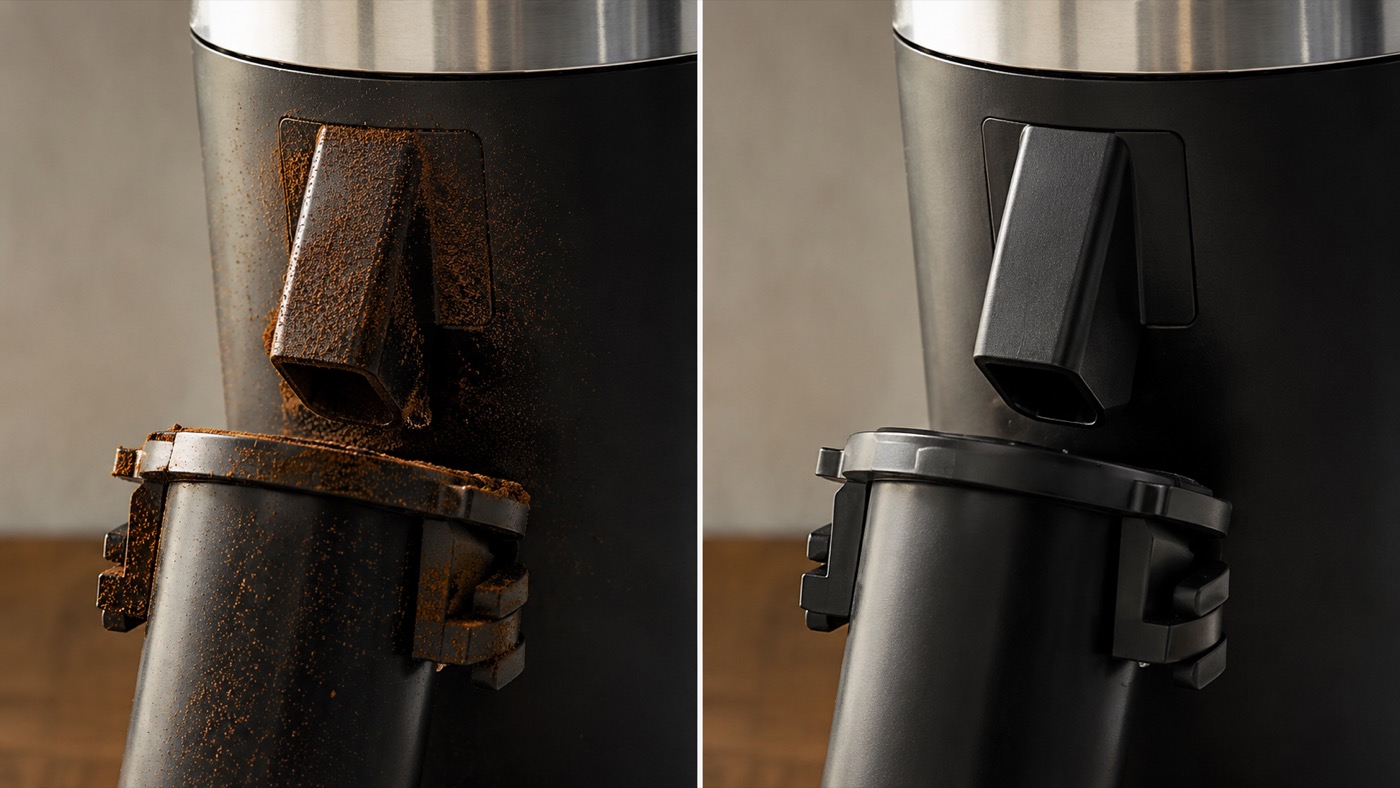
Stale grounds inside the machine
Coffee oils go rancid. They coat the inside of the grinder, the burr faces, and the chute, and they taste exactly as good as they sound. On a grinder used daily this is worth attention every few weeks.
For a light clean, brush out the chute and the visible burr area. For a proper one, remove the top burr and brush both faces and the housing. Grinder cleaning tablets work but are not a substitute for actually opening it.
Most burrs are hardened steel and will rust. Brush them dry, or use a dedicated cleaner. If you must use anything wet, dry them immediately and completely.
Burr wear
Burrs are consumable. As the cutting edges dull, they crush more and cut less, which widens the particle distribution and produces more fines. The change is gradual enough that you adapt to it without noticing.
Rough guidance for steel burrs: 500 to 1000 kg of coffee for commercial sets, far less for the small burrs in home grinders. Most home users will never hit a replacement interval, but if your grinder is a decade old and heavily used, or was bought secondhand with unknown history, worn burrs are a real possibility.
The symptom is needing a progressively finer setting over time to hit the same shot time, along with shots that taste increasingly muddled at every setting.
Alignment
If the burrs are not parallel, part of the circumference grinds finer than the rest and your distribution is permanently wide. Some grinders arrive misaligned from the factory.
The classic test is the marker test: colour the burr face with a permanent marker, run the grinder briefly at a fine setting, and see where the ink is removed. Even wear all the way around means good alignment. Ink surviving on one side means it is not touching, and you have a tilt.
A maintenance rhythm worth keeping
- Every dose: RDT if you get static. Purge if your grinder retains.
- Weekly: brush the chute and exit path.
- Monthly: open it up, brush both burr faces and the housing.
- When you change coffee: purge a couple of grams so you are not tasting the last bag.
- Occasionally: check alignment with the marker test, especially after transport.
Shoot the same setting once a month in the Grind Lab. If the particle size has moved while the dial has not, something in the grinder has changed.
Open the Grind Lab