
 BARISTUNOBy Barista in Pajamas
Conical vs flat burrs: what actually changes
The most repeated claim in home coffee is that flat burrs give clarity and conical burrs give body. Here is what the geometry really does, and how much of the rest is folklore.
Browse all articles 13
Grinders
- Conical vs flat burrs: what actually changes
- Does burr size actually matter?
- Grinder habits that quietly cost you shots
- Grind size by brew method, in microns
Beans
- Roast levels, and why they change how you grind
- Washed, natural, honey: what processing does to the cup
- How long to rest coffee, and how to store it
Espresso
Technique
Ask which burr geometry is better and you will get an answer within seconds, delivered with total confidence, and it will contradict the last answer you got. It is worth separating the part that is mechanical fact from the part that is received wisdom.
The geometry
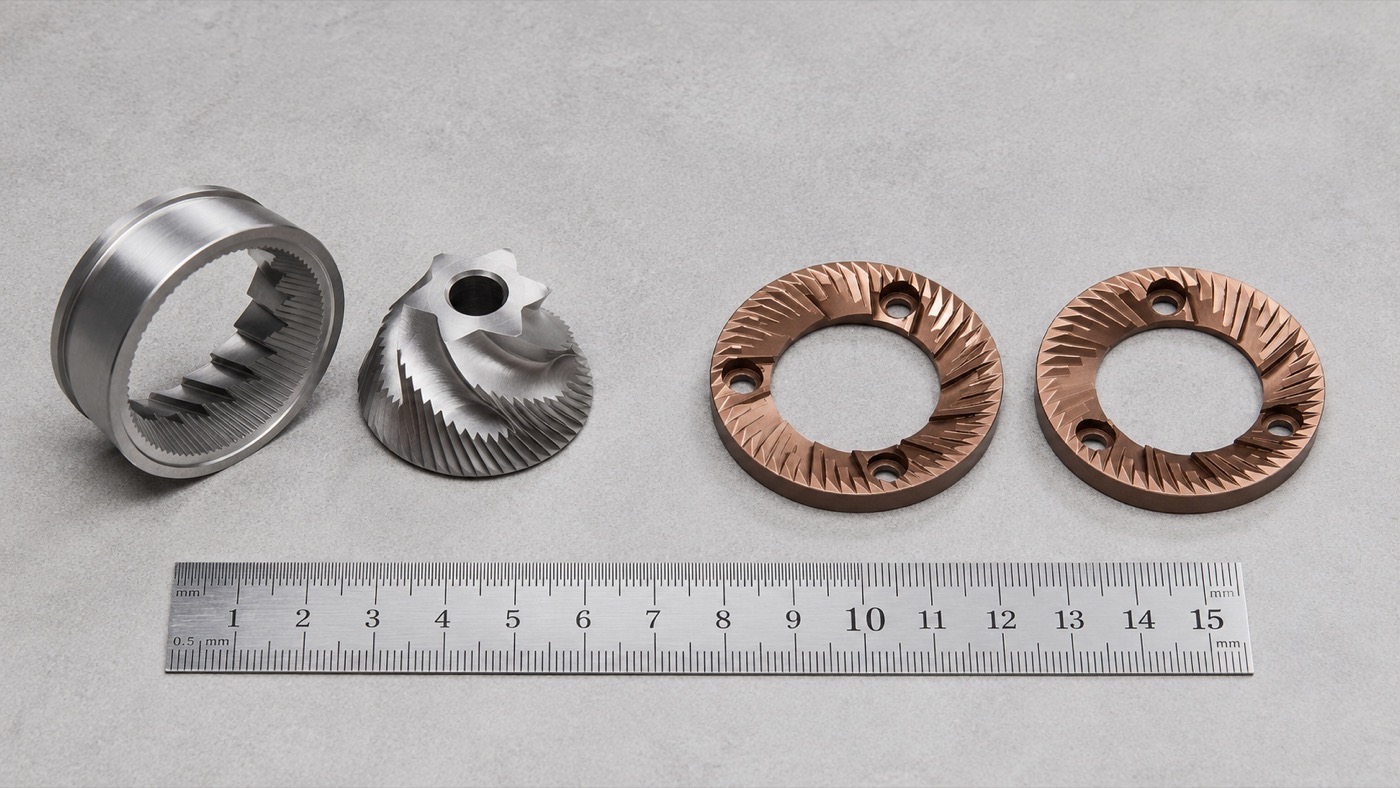
A conical burr is a ridged cone sitting inside a ridged ring. Beans fall into the gap at the top, get broken by the coarse upper ridges, then travel down a narrowing channel where finer ridges cut them to size. Gravity does most of the transport work, helped by the auger shape of the cone itself. That is why almost every hand grinder is conical: the geometry tolerates the low, uneven RPM of a human arm.
A flat burr is two parallel rings facing each other, one spinning. Beans enter at the centre and are thrown outward by centrifugal force, passing through progressively finer cutting territory until they exit the rim. Nothing falls through; particles only leave when they are small enough to be flung past the outer edge.
That last difference is the one that matters. In a conical, a particle that is already fine enough can fall straight out. In a flat, everything takes roughly the same journey across the burr face before it escapes.
What that does to the grind
The classic claim is that conical burrs produce a bimodal distribution, meaning two humps: a main population of boulders plus a distinct second population of fines. Flat burrs are said to produce something closer to a single narrow peak.
There is something to this. The escape route explains it: in a conical, fines generated early can drop out immediately without further grinding, while the coarse fraction keeps travelling. You end up with two populations that had different journeys.
But the size of the effect is routinely overstated. Every grinder produces fines, in quantity, regardless of geometry. Fracturing a brittle roasted bean always throws off dust; that is a property of the bean, not the burr. Both geometries produce a fines peak. What differs is how pronounced the separation is, and by less than the internet suggests.
Most published particle comparisons vary the grinder, not just the geometry, which means burr design, alignment, RPM, and burr wear all move at the same time. Very few compare a conical and a flat that are matched on everything else, because such a pair barely exists. Treat any confident universal claim here with suspicion, including this one.
The taste question
The shorthand is that flat burrs taste "clean, separated, high clarity" and conical burrs taste "sweet, textured, more body". Enough experienced people report this that it is probably not nothing. But it is very hard to isolate, because the grinders being compared differ in a dozen other ways, and because the taster usually knows which is which.
A more defensible way to put it: a narrower distribution extracts more uniformly, and uniform extraction reads as clarity and separation of flavours. A wider distribution extracts unevenly, with the fines over-extracting while the boulders under-extract, and that mix can read as body and complexity, or as muddiness, depending on how far it goes and whether you like it.
Neither is correct. They are different distributions, and which one flatters a given coffee is a matter of taste and of what you are brewing.
What actually matters more
Three things move your cup more than the choice between cone and ring:
- Alignment. If the burrs are not parallel, part of the circumference cuts at a different gap than the rest, and you get a wide distribution no geometry can rescue. A well-aligned budget grinder beats a misaligned expensive one.
- Burr design within the category. The difference between two flat burr sets, one cut for espresso and one for filter, is larger than the average difference between flats and conicals. Tooth pattern, rake angle, and the length of the cutting zone all matter.
- Wear. Burrs dull. A worn set produces more fines and a wider spread. Most home users never replace them.
So which should you buy
For a hand grinder, the question is settled: conical, because flat burrs need sustained speed a hand cannot supply comfortably. For an electric espresso grinder in the mid range, both are good and the specific model matters far more than the category. For filter, large flats have a real reputation for clarity that is worth paying for if that is the cup you want.
What you should not do is buy on geometry alone, or assume your grinder is holding you back because it has the wrong kind of burr. It probably is not.
Conicals let fines escape early, which tends toward a more separated two-population grind. Flats make everything take the same path, which tends toward a narrower one. The tendency is real, the magnitude is smaller than claimed, and alignment and burr design swamp it in practice.