
 BARISTUNOBy Barista in Pajamas
Does burr size actually matter?
38 mm, 64 mm, 83 mm, 98 mm. Bigger burrs cost more and are marketed hard. Here is what the extra diameter buys you, and where the returns stop.
Browse all articles 13
Grinders
- Conical vs flat burrs: what actually changes
- Does burr size actually matter?
- Grinder habits that quietly cost you shots
- Grind size by brew method, in microns
Beans
- Roast levels, and why they change how you grind
- Washed, natural, honey: what processing does to the cup
- How long to rest coffee, and how to store it
Espresso
Technique
Burr diameter is the easiest specification to put on a box, so it gets used as a proxy for quality. It is a real variable, but what it changes is narrower than the marketing implies.
The mechanical argument
A larger burr has more cutting edge in contact with the coffee per rotation. That means a bean is reduced in fewer passes and spends less time being knocked around in the grinding chamber. Two consequences follow, and both are genuine:
- Less heat. Grinding is friction. Less time in the chamber and more surface to dissipate into means the grounds come out cooler. Heat drives off aromatics and, at the extreme, makes grounds clump.
- Fewer fines from re-grinding. A particle that has already reached target size but cannot escape yet will get hit again, and each hit sheds dust. Larger burrs clear faster, so less of this happens.
There is a third consequence that matters more to cafes than to you: throughput. An 83 mm flat will grind a double dose in a couple of seconds. A 40 mm hand grinder takes half a minute of effort. If you are pulling forty shots an hour that is the whole argument.
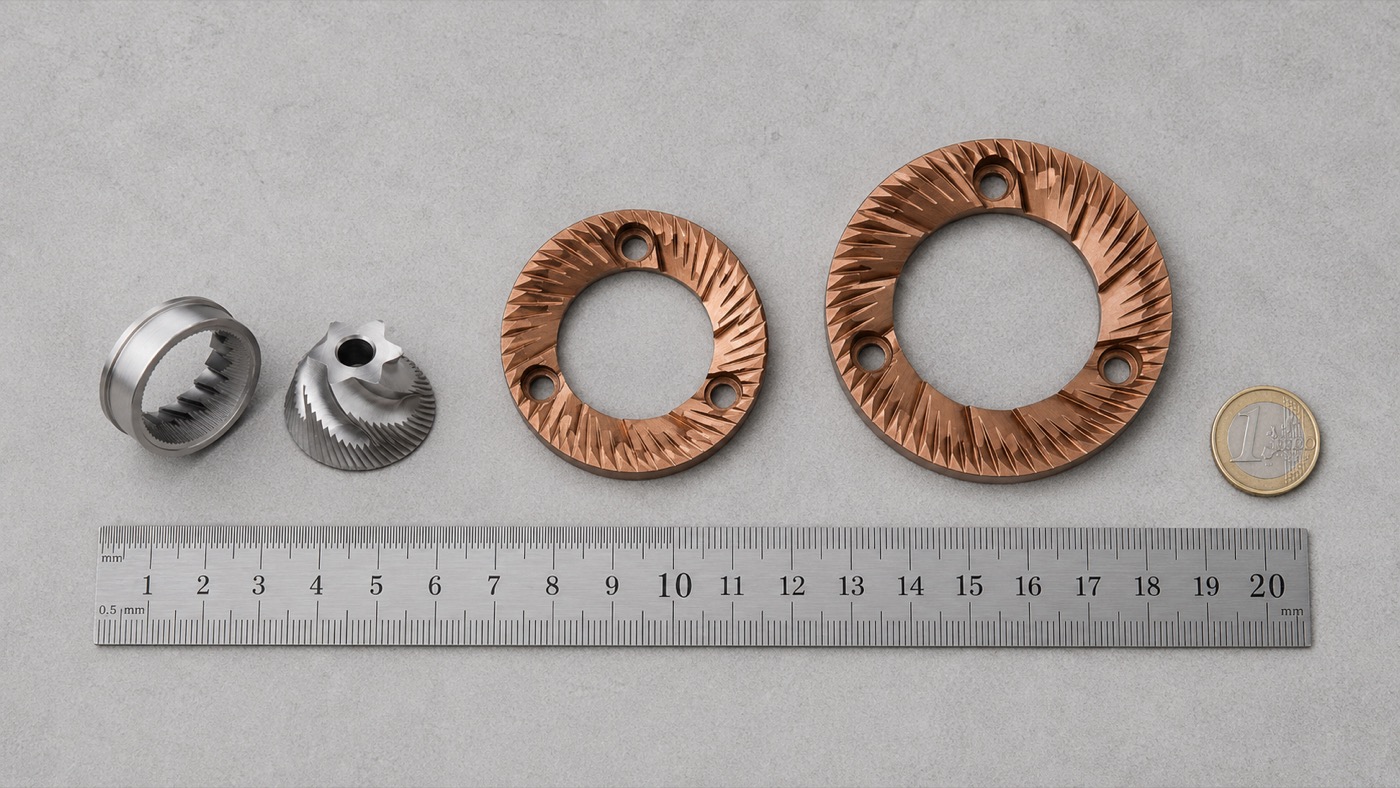
Where it stops paying
The jump from a 38 to 48 mm hand grinder burr up to a well-built 64 mm flat or conical is noticeable. You get faster grinding, cooler grounds, and usually a better-engineered machine around the burrs.
The jump from 64 mm to 83 mm is mostly about speed and consistency at volume. In a home setting, grinding 18 grams once or twice a day, the cup difference is small and easily swamped by everything else in your routine. You are paying for a commercial duty cycle you will never use.
Parallelism error scales with diameter. A tilt that is negligible across 40 mm becomes a meaningful gap difference across 98 mm. Large-burr grinders need better manufacturing tolerances to deliver on their specification, and not all of them do. A misaligned 83 mm flat can genuinely grind worse than a well-aligned 54 mm.
Mass, warmup, and retention
Larger burrs usually sit in heavier machines. That thermal mass stabilises the grinder once it is up to temperature, but it also means the first grind of the day comes out of a cold machine and behaves differently from the fifth. If you notice your first shot of the morning always runs differently, this is part of why.
Retention is a separate issue and correlates poorly with size. It is a function of chamber geometry, exit path, and static, not diameter. Some large grinders retain almost nothing; some small ones hold a gram and a half.
| Size | Typically | What you actually get |
|---|---|---|
| 38-48 mm | Hand grinders | Perfectly capable of excellent espresso. Slow, and effortful at fine settings. |
| 54-64 mm | Home electric | The sweet spot for most people. Fast enough, cool enough, affordable enough. |
| 75-83 mm | Prosumer / light commercial | Speed and consistency under load. Diminishing cup returns at home. |
| 98 mm+ | Commercial | Volume. Buying one for a home kitchen is buying throughput you will not use. |
What to spend on instead
If you have a fixed budget, the ranking that tends to hold: alignment and build quality first, then burr design suited to what you brew, then diameter. A carefully built 64 mm grinder with burrs cut for espresso will beat a sloppy 83 mm every time.
Bigger burrs run cooler, generate fewer re-grind fines, and clear faster. Those are real. But the curve flattens hard above about 64 mm for home use, and alignment quality matters more than the number on the box.